


What would change for Lagos if homes, businesses and industries could finally count on electricity around the clock?
That is the ambition behind a fresh push by the Lagos State Government to increase available electricity supply to 3,500 megawatts (MW) and move the state closer to reliable 24-hour power.
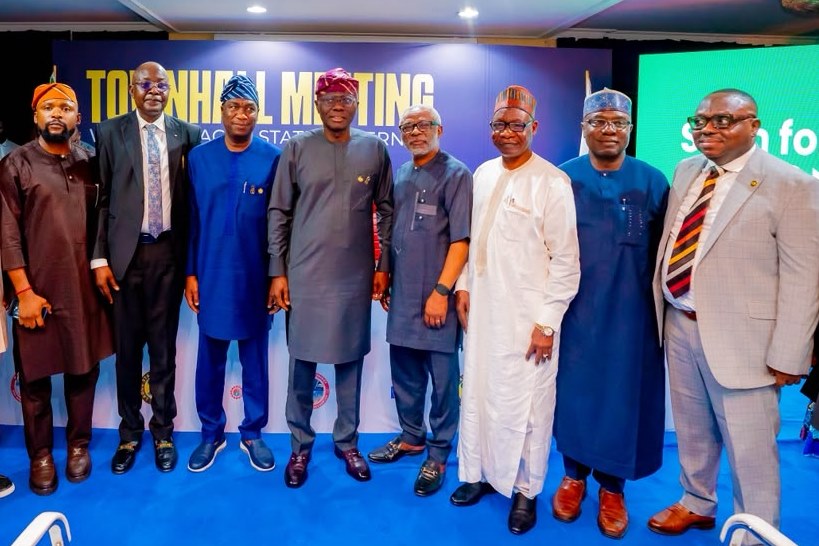
Governor Babajide Sanwo-Olu announced the target on Thursday at the Lagos State High-Level Strategic Power Town Hall at Lagos House, Marina, where stakeholders across the electricity sector gathered to examine why Lagos continues to experience power shortages — and what can be done differently.
The meeting brought together regulators, electricity distributors, transmission operators, investors, asset managers and representatives of both the Federal and Lagos State Governments.
For Sanwo-Olu, the solution cannot focus on generation alone.
He called for coordinated action across generation, transmission, distribution and metering, alongside stronger data management, smart metering, enforcement and revenue assurance.
The goal, he said, is to build a more reliable electricity market that can attract investment and give consumers greater confidence in the system.
Lagos Needs More Than 3,500MW
The scale of the challenge became clearer during the meeting.
Minister of Power Joseph Tegbe, represented by the Director of Distribution Services, Engr. Baba Mustapha, said Lagos requires more than 6,000MW, significantly above the state’s current available supply from the national grid.
But producing more electricity will not automatically solve the problem.
He identified gas supply, generation capacity, transmission limitations, distribution bottlenecks and metering as critical areas that must be addressed together.
In other words, more power at the generating plant means little if the network cannot deliver it to the customer.
The Bigger Question: Can Lagos Build Its Own Electricity Market?
Special Adviser to the President on Power and Chairman of the Presidential Taskforce on Power Sector Reset and Restoration, Dr. Rilwan Lanre Babalola, said the challenge is no longer simply about producing more electricity.
Nigeria, he argued, needs a functioning and sustainable electricity market.
He said Lagos must move away from a system where government repeatedly absorbs losses and instead create an environment where generators, gas suppliers, network operators and consumers can operate within a transparent and commercially viable system.
One proposed solution is the Clean Lagos Electricity Market (CLEM).
The model is expected to use demand aggregation, bilateral contracts, open access, payment assurance and transparent settlement to turn Lagos’ huge electricity demand into an investable market.
The key questions, Babalola said, are straightforward: Where are the customers? Where will the electricity and gas come from? Can the network deliver the power? What should consumers pay? And how will the money move transparently through the system?
The constitutional amendments and Electricity Act, he added, have also created greater opportunities for states to establish and regulate their own electricity markets.
‘Consumers Should Not Pay for Darkness’
For Lagos Commissioner for Energy and Mineral Resources, Abiodun Ogunleye, the immediate objective is clear: end what he described as the culture of blackout.
He said the government would develop specific action points from the town hall and establish a baseline against which progress can be measured during a proposed six-month review.
But there is another side to the electricity equation: payment.
Ogunleye stressed that improved electricity supply must go hand in hand with payment for electricity consumed.
His position was blunt: consumers should not be asked to pay for darkness.
At the same time, the system cannot improve sustainably if customers consume electricity without paying for it.
What About the Distribution Network?
The Lagos State Electricity Regulatory Commission CEO, Temitope George, identified several obstacles affecting supply, including generation and transmission constraints, energy theft, vandalism and non-payment of electricity bills.
She urged consumers to pay for the electricity they use, warning that widespread non-payment weakens the electricity market and ultimately affects the ability of other consumers to receive reliable supply.
Lagos is also exploring embedded power generation to supplement electricity from the national grid and reduce the state’s dependence on the national system.
The government also plans to work with distribution companies to monitor selected feeders and measure whether electricity supply is actually improving.
Newly commissioned substations are expected to add capacity to the state’s electricity infrastructure.
So, What Happens Next?
The town hall was not presented as another meeting to discuss the same problems.
Stakeholders agreed to translate the discussions into specific action points, measurable baselines and periodic reviews.
The proposed six-month review will provide an opportunity to assess whether those commitments are producing results.
For Lagos residents, however, the ultimate measure will be much simpler than megawatts, tariffs or regulatory frameworks.
Can the lights stay on?
The state is targeting 3,500MW and pushing for a more coordinated electricity market.
But the real test will be whether that ambition eventually translates into reliable electricity for homes, businesses and industries — and whether Lagos can finally move from managing blackouts to preventing them.
Leave a Reply