


What does it mean when reports of Domestic and Sexual Violence begin to fall?
For Lagos State, the answer is not simply that the problem is disappearing.
The State Government says 33,009 cases of Domestic and Sexual Violence were reported between September 2021 and July 2026, but cautions that a decline in reported cases does not automatically mean a similar decline in the actual prevalence of violence.
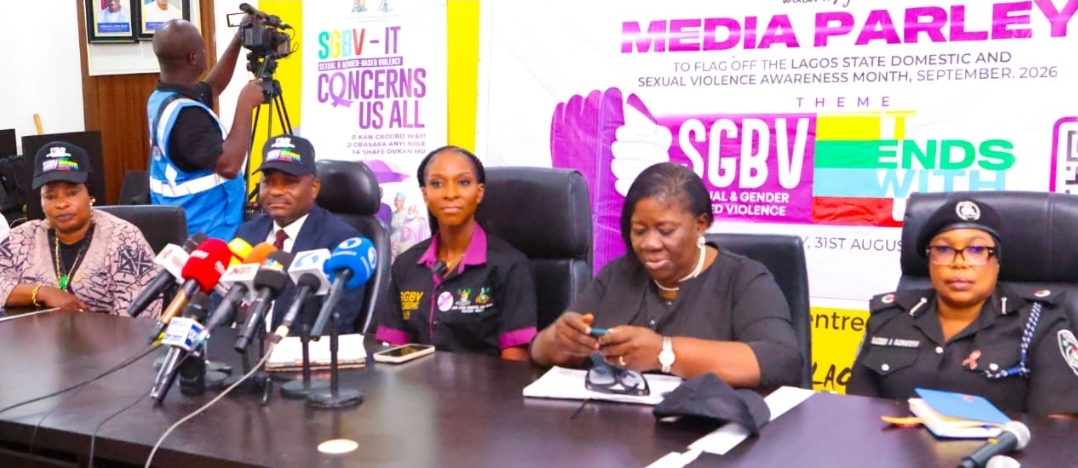
The Attorney-General and Commissioner for Justice, Mr. Lawal Pedro, SAN, disclosed the figures on Monday at a media parley marking the beginning of the 2026 Domestic and Sexual Violence Awareness Month.
His message was clear: the ultimate goal is not fewer cases on government records, but fewer people experiencing violence in the first place.
33,000+ REPORTS — WHAT THE NUMBERS SHOW
According to data from the Lagos State Domestic and Sexual Violence Agency (DSVA), domestic violence remains the most frequently reported form of abuse.
Between September 2021 and July 2026, the Agency recorded:
33,009 total cases
13,515 domestic violence cases
1,171 defilement cases
797 child abuse and physical assault cases
420 rape cases
428 sexual harassment cases
100 sexual assault by penetration cases
323 threats to life
79 attempted rape cases
1,861 family-related disputes
But perhaps the most troubling figure concerns children.
10,613 children were identified as suffering emotional abuse after being exposed to domestic violence in their homes.
They may not have been the direct victims of the violence, but the State says exposure to abuse can leave long-term psychological consequences.
ARE CASES REALLY FALLING?
The annual figures show a changing pattern.
Lagos recorded 1,075 cases between September and December 2021, followed by:
2022 — 5,929
2023 — 6,389
2024 — 7,882
2025 — 7,721
2026 — 4,013 cases as of July.
The State says the two consecutive years under review show a 23.6 per cent decline in reported cases.
But Pedro stressed that government is deliberately avoiding the temptation to celebrate the numbers prematurely.
Why?
Because reported cases only represent incidents that reach the attention of the Agency.
Changes in awareness, reporting behaviour, access to support services and the channels through which survivors seek help can all influence the figures.
In other words:
Fewer reports do not automatically mean fewer incidents.
For Lagos, the real measure of success will be whether fewer residents are actually experiencing violence.
The data becomes even more disturbing when children are considered.
Among reported cases involving children, emotional abuse accounted for 82.3 per cent, followed by defilement at 8.2 per cent and physical assault or child abuse at 6.6 per cent.
The State also reported that 90 per cent of survivors experienced psychological consequences, including low self-esteem, extreme fear, anxiety and Post-Traumatic Stress Disorder.
Approximately five per cent experienced depression severe enough to require medical attention.
The figures reinforce the argument that SGBV is not simply a criminal justice issue.
It is also a mental health, family, education, healthcare and social welfare issue.
FROM REPORTING TO RESPONSE
Lagos says receiving a complaint is only the beginning.
During the period under review, the State provided free legal support to 175 survivors, while 40 survivors were accommodated in Eko Haven and other safe shelters.
The Agency’s Clinical Psychology Department provided psychotherapy and counselling to:
953 survivors, 267 alleged perpetrators and 304 children.
DSVA also carried out 501 rescue operations and supported 46 persons with disabilities experiencing gender-based violence.
On the justice side, the Agency secured 20 restraining orders, financially supported the investigation and prosecution of 464 SGBV-related cases, while more than 711 cases were charged to court.
The Directorate of Public Prosecutions secured over 160 convictions during the period.
WHY DO SURVIVORS DELAY REPORTING?
The State’s data also offers insight into why some victims remain in abusive situations for years.
At least 35 per cent of survivors reporting domestic violence experienced the abuse within the first five years of marriage, while seven per cent reported abuse after more than 10 years of marriage.
Financial dependence, concerns about children and socio-cultural pressures were identified among factors that can influence delayed reporting.
The data also shows that 30 per cent of women who reported abuse said they were pregnant when the violence occurred.
And the perpetrators are not confined to one economic group.
Among alleged perpetrators, 31 per cent were employed, 45 per cent self-employed and 12 per cent unemployed.
For government, this reinforces one important point:
Poverty or unemployment alone cannot explain domestic and sexual violence.
WHERE ARE MOST CASES BEING REPORTED?
Among adult cases, the highest reporting came from:
Alimosho, Ikorodu, Eti-Osa, Kosofe and Ikeja.
For children, the leading areas were:
Alimosho, Eti-Osa, Ikorodu, Kosofe and Ifako-Ijaiye.
The State says these figures will help guide prevention, awareness and response interventions across communities.
LAGOS TAKES THE MESSAGE TO THE GRASSROOTS
The State says it is increasingly moving beyond responding after violence occurs to preventing it before it happens.
Through door-to-door campaigns, market sensitisation, school outreach and Community Development Association engagements, DSVA reached an estimated 1.96 million residents across Lagos’ 20 Local Government Areas.
More than 700 safeguarding and child protection officers across the six education districts also received capacity building.
Over 60,000 educators, parents and caregivers have been equipped through the Lagos State Safeguarding and Child Protection Online Course.
The State has also established DSVA sub-offices in Kosofe and Ikorodu to bring services closer to residents.
TECHNOLOGY JOINS THE FIGHT
Lagos is also expanding the ways residents can seek help.
The Agency reintroduced its *6820# USSD service in October 2025, providing an additional channel for residents who may not have smartphones or reliable internet access.
It also operates the ASK INU WhatsApp chatbot and the Virtual Referral and Response Service.
For survivors and members of the public, the State’s toll-free reporting line remains:
08000-333-333.
WHAT HAPPENS IN SEPTEMBER?
This year’s Domestic and Sexual Violence Awareness Month carries the theme:
“SGBV — IT ENDS WITH US.”
The campaign will include activities across Lagos throughout September.
These include:
Turn Lagos Purple — September 1
Turn Alausa Purple — September 2
Training of medical social workers — September 3
Police training on SGBV response and investigation — September 3–4
Caring for the Carers mental wellness programme — September 5
Disability-inclusive case management training — September 7
Advocacy Walk Against SGBV — September 8
Training of newly recruited health workers — September 9–10
Survivors’ Day — September 15
Private-sector engagement on workplace sexual harassment — September 16
Market Fiesta at Ile-Epo Market — September 17
Safeguarding and Child Protection Week — September 21–25
National Convening of GBV State Coordinators and launch of the Lagos State GBV Prevention Policy — September 24–25
Governor’s Commendation and Awards Night — September 29
THE BIGGER SHIFT
Perhaps the biggest message from Lagos this year is the shift from a response model focused mainly on what happens after violence to one increasingly focused on what can be done before it occurs.
That means working with schools, traditional institutions, religious leaders, families, workplaces, markets, healthcare workers, the police and communities.
Because by the time a survivor reports an assault, the damage may already have been done.
The State says the better outcome is prevention.
No survivor. No crime. No trauma.
That is why Lawal Pedro says Lagos will continue to analyse its data, strengthen reporting channels, expand access to justice and support survivors — while confronting the attitudes and behaviours that allow violence to thrive.
And the message for September is deliberately personal:
SGBV — IT ENDS WITH US.
For the survivor: you deserve safety, dignity and justice.
For the family member, friend, neighbour or colleague: do not look away.
And for every Lagosian:
Speak up. Report. Support survivors. And help build a Lagos where violence is prevented before it happens.
Leave a Reply