


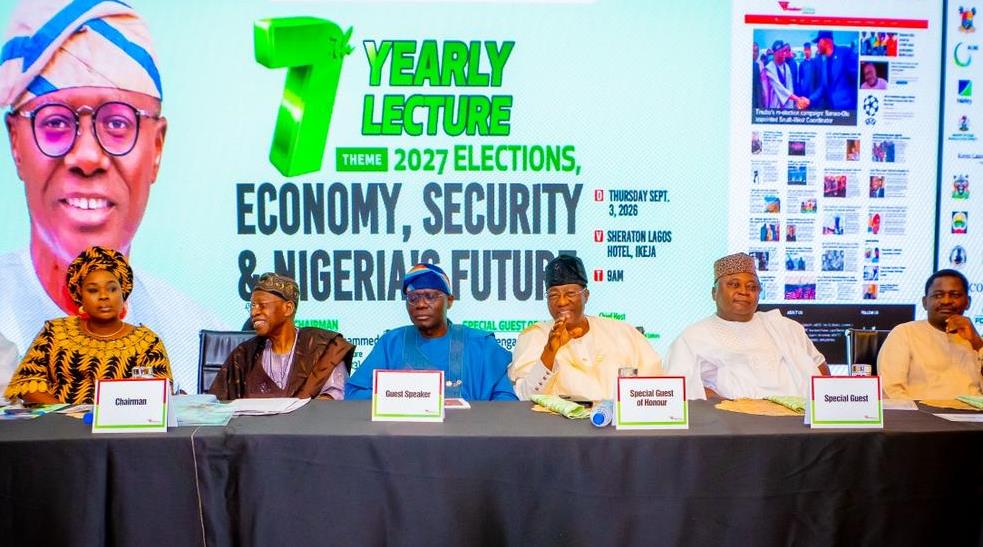
…..Lagos Governor defends Tinubu’s economic reforms, says subsidy removal has been painful but argues Nigeria’s fiscal position is improving
What happens when a policy that has been painful for millions of Nigerians becomes a campaign promise again?
That question is likely to feature prominently as Nigeria moves towards the 2027 elections.
For Lagos State Governor Babajide Sanwo-Olu, the answer is straightforward: promises to restore the fuel subsidy should not be taken at face value.
Speaking at the 7th Freedom Online Newspaper Lecture in Ikeja, the Governor described calls for the return of the subsidy as “empty campaign buzz”, arguing that the policy is no longer fiscally realistic.
The lecture, themed “2027 Elections, Economy, Security and Nigeria’s Future,” brought together political leaders, media practitioners and other stakeholders to examine where Nigeria stands ahead of another election cycle.
WHY THE SUBSIDY ARGUMENT MATTERS
Sanwo-Olu acknowledged that removing the subsidy has not been painless.
Nigerians have felt the impact through higher transport costs, food prices and increased pressure on household incomes.
But the Governor argued that the bigger question is what the country gains by ending a system he described as a major drain on public finances.
According to him, the subsidy was originally introduced to address weaknesses in domestic fuel supply but eventually became a financial burden that consumed resources that could otherwise have gone into roads, schools, hospitals and other public infrastructure.
He said President Bola Ahmed Tinubu took the political risk of ending the programme despite the possible electoral consequences.
“The measure of a reform is not whether it hurts. It is whether it heals.”
That may ultimately become one of the defining arguments of the 2027 political debate.
BUT HAS THE REFORM STARTED TO WORK?
The Governor’s defence of the reform was built largely around economic figures.
Sanwo-Olu said Nigeria’s economy grew by 4.43 per cent in 2026, compared with 3.89 per cent in the first quarter and 4.23 per cent recorded in the first quarter of 2025.
He also cited growth in agriculture and services, stronger external reserves, a trade surplus and an improvement in Nigeria’s credit ratings.
He said inflation, which had reached almost 35 per cent at the end of 2024, had fallen to 15.9 per cent last June.
The Governor also pointed to diaspora remittances, saying Nigerians abroad sent $947 million through formal channels in July, describing it as the highest monthly figure recorded.
But Sanwo-Olu was careful to acknowledge the other side of the numbers: the reforms have imposed real costs on citizens.
And that distinction matters.
Because economic recovery on paper does not automatically translate into cheaper food, lower transport fares or more money in the pockets of ordinary families.
MORE MONEY FOR STATES?
One of Sanwo-Olu’s strongest arguments was the effect of subsidy removal on government revenues.
He said monthly allocations to states and local governments have more than doubled in naira terms since the subsidy was removed.
His argument is that the additional revenue gives sub-national governments more resources to invest in infrastructure and public services.
That, however, raises another question:
Are Nigerians beginning to see the benefits of the additional revenue in their everyday lives?
For state governments, the answer may be found in projects and services delivered with increased allocations.
For citizens, the measurement is likely to be much simpler — whether life is becoming more affordable and opportunities are expanding.
NIGERIA’S DEMOCRACY: HOW FAR HAVE WE COME?
Sanwo-Olu’s lecture went beyond the economy.
He also offered a positive assessment of Nigeria’s democratic journey since 1999, arguing that the country’s electoral system has evolved despite democratic reversals in parts of West Africa.
He pointed to countries including Mali, Guinea, Burkina Faso, Niger and Guinea-Bissau, where military interventions have disrupted democratic rule.
According to the Governor, Nigeria’s electoral reforms — including technological improvements in voter verification and results transmission — represent progress from the elections of the early 2000s.
But he also warned against complacency.
With the 2027 elections approaching, he said the Independent National Electoral Commission must be ready to conduct credible elections across the country.
The implication is clear: democratic progress is measured not simply by surviving elections, but by continually improving how those elections are conducted.
CAN SECURITY BE SEPARATED FROM THE ECONOMY?
On security, Sanwo-Olu argued that poverty remains one of the major drivers of insecurity, particularly among young Nigerians.
He highlighted Federal Government interventions targeting youth education, employment, credit and skills development, alongside increased investment in the security architecture.
Among the programmes he mentioned were NELFUND, the Consumer Credit Corporation, the 3 Million Technical Talent programme, reforms to the NYSC, the Nigerian Youth Academy and other youth-focused initiatives.
The Governor’s argument is that security cannot be addressed by military and police action alone.
A young person with education, skills, employment and a stake in the economy, he suggested, has less incentive to become part of an insecure or violent system.
That makes job creation not just an economic policy, but a security strategy.
THE 2027 QUESTION
Former Minister of Information and Culture Lai Mohammed, who chaired the lecture, also linked the economy, security and politics.
He argued that political stability depends heavily on economic inclusion and that insecurity makes it difficult for businesses to thrive.
His warning was equally relevant to the coming election:
Politics must not become more important than governance.
For the Freedom Online Newspaper’s Editor-in-Chief, Gabriel Akinadewo, the renewed political activity ahead of 2027 should instead be an opportunity for politicians to place national development above political calculations.
He also called for Nigeria’s laws to be modernised to reflect contemporary realities and citizens’ aspirations.
THE BIGGER QUESTION
Sanwo-Olu’s argument is ultimately about more than fuel subsidy.
It is about whether Nigerians should judge a government by the immediate pain of reform or the longer-term results that reform is supposed to produce.
The opposition will have its own answers. Citizens will have their own experiences. And as 2027 approaches, promises will become louder.
But one question may be harder to avoid:
If subsidy is brought back, where will the money come from — and what will Nigeria have to give up to pay for it?
Ask Lagos — because sometimes, the real story begins when we ask: is a promise affordable, or is it simply good campaign politics?
Leave a Reply